126th Street Harlem African Burial Ground Memorial and Mixed-Use Project
Honoring and memorializing the historic Harlem African Burial Ground with a new outdoor memorial and indoor cultural center and addressing affordable housing and jobs needs in the East Harlem community.
The History
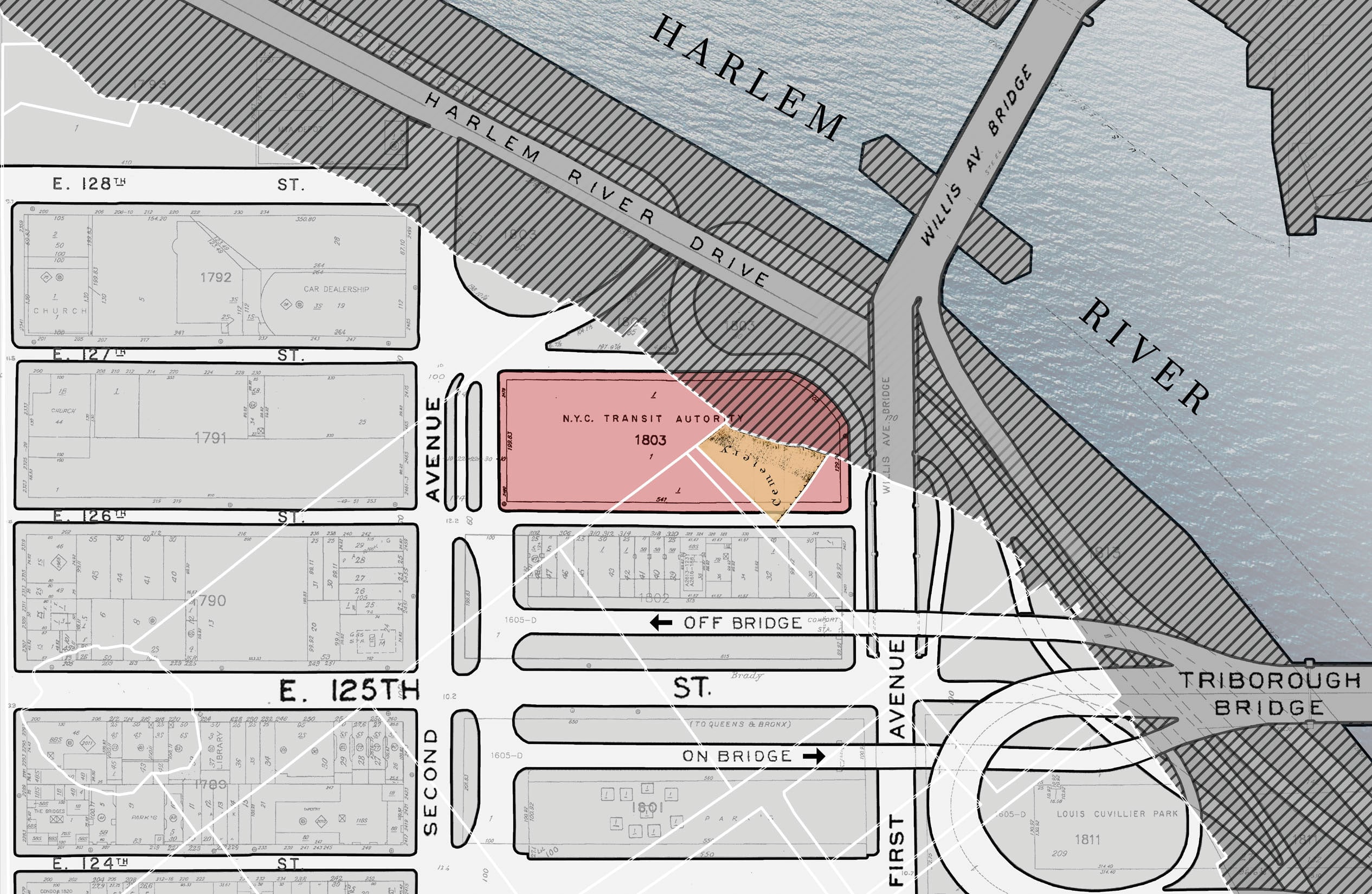
The 126th Street Harlem African Burial Ground Memorial and Mixed-Use Project honors and memorializes an important part of the city's history and addresses needs of the East Harlem community. The 2.7-acre project site is a full Manhattan city block located at 126th Street and 2nd Avenue in East Harlem that is currently occupied by the MTA’s decommissioned 126th Street Bus Depot. The historic footprint of the Harlem African Burial Ground occupies 0.4 acres on the southeast portion of the site.

Unearthing Our Legacy Together: Sharing the History of the Harlem African Burial Ground and Planning for the Future
Video Transcript
0:10: It's been a long time. We came here, this was a mysterious place with so many unknown constraints, and we had to review hundreds of pages of PDFs to try to understand of the as-builts, to understand how the site has been transformed over time.
0:27: I went over to those boxes that I just laid my hands on, and I felt something. It was so emotional that tears... I couldn't stop crying.
0:44 [Music.] [Clip of people sitting in chairs facing a white columned building during an outdoor event, followed by a busy street view of Harlem with the Apollo Theater sign and pedestrians. Overlaid text on both clips reads: “Unearthing Our Legacy Together: Sharing the History of the Harlem African Burial Ground and Planning for the Future.”]
0:52 For two centuries, New Yorkers of African descent were laid to rest at a burial ground sitting at 126th Street in East Harlem. But over time, the history of this site was lost, erased by centuries of displacement, development, and neglect.
1:10 [Jennifer Sun, Executive Vice President, Planning Division, NYCEDC.] The Harlem African Burial Ground was in place around the 1600s as a result of the low Dutch Reformed Church creating this cemetery for descendants of African descent, enslaved and free, in one cemetery. And then in a different cemetery, they had also interred people of European descent. So, these were cemeteries that were in place since the 1600s through the late 1800s.
1:36 [Sharon Wilkins, Harlem African Burial Ground Initiative, Former Manhattan Deputy Borough Historian.] It was common practice to segregate burial spaces. A space was created called God's Acre for the burial of people of European descent, and a separate space that was not only segregated but disrespected, because from time to time it was used for the grazing of animals. Animals were grazing, and people were farming and doing other things while funerals were going on. There was gross disrespect from the beginning, and of course, that continued in this burial space that that is known as the negro or African Harlem African Burial Ground.
02:19 [Jennifer Sun] As the city began to expand northward, there were more developments happening in the area surrounding the Harlem African Burial Ground. The church made the decision to care for the remains of those of European descent by removing the remains to Woodlawn Cemetery in the Bronx, but they left behind the remains of those who were buried in the Harlem African Burial Ground. Through the course of development since the 1800s, those remains were disturbed, dislocated, really erasing the existence and the remembrance of this site as a Harlem African Burial Ground, because instead what people experienced and saw in its place were the different kinds of commercial development that had happened. Those uses included beer garden, military barracks, movie production studios. People probably had no conception, or any sense that there were people buried there who were part of the city's development in its early colonial history.
03:18 [Reverend Dr. Patricia A. Singletary, Harlem African Burial Ground Initiative, Pastor Emerita of the Elmendorf Reformed Church.] I receive a call from the of the director who was building the Willis Avenue Bridge and said, “Do you know that your church is the owner of some remains?” And then I called Congressman Rangel. He said, “The first thing you need to do, go to your city council person.”
03:44 [Melissa Mark-Viverito, Harlem African Burial Ground Initiative, Former City Council Speaker and Council Member for District 8.] I was city council member here in the eighth councilmanic district from 2006 through the end of 2017, and was speaker of the city council for the last four years of my term. The Elmendorf church, Reverend Singletary approached me in my first term when I was in the council and said, “Hey, did you know?” And I was fascinated obviously by the history of it. It’s a dark history, but the history of it. And she indicated that she was very much interested in getting support from the elected officials in order to memorialize, right, that cemetery. And so, that's how I came about to know, to learn about it, was through her advocacy. I told her: “Well, I'm here to help. I think this is really important for the larger community to really understand that we memorialize the space. So, why don’t we develop a working group where that is cheered by you, Reverend Singletary, myself, my office, and that we could convene, right, other electeds and other stakeholders in the community to really figure out how we push this project forward.
04:50 [Rev. Singletary] Melissa gave me the impetus to go and do and ask people would they be a part of the task force and why. And we had over 30-35 at a time around the task force for different churches coming in, and we research and had a research team within that group.
05:12 [Melissa Mark-Viverito] So, that task force served as the agency and the vessel by which we could convene agencies, stakeholders, other elected officials to advance the agenda of what Elmendorf was asking us to do. And so, that was something that was very effective in creating that task force.
05:33 [Melinda Velez, Harlem African Burial Ground Initiative, Former NYC Council District Chief of Staff for Melissa Mark-Viverito.] We have a mutual respect and liking of one another, so that transcended the usual community meeting, community members. No, we literally came together like a small family, and we all had the same vision. So yeah, I think it could not have happened without these powerful women at the hub.
05:55 [Melissa Mark-Viveretto] Where we are going to have the bus depot that has been decommissioned, that a part of that bus depot is on the perimeter, or within right where that burial ground was. We have developed partnership with the city, a very strong partnership with EDC, but we've got to a point of now being able to work side by side, been an incredibly strong partner to advance this project and be where we are today.
06:19 [Erich Bilal, Former Vice President, Neighborhood Strategies, NYCEDC, Executive Director, Public Design Commission.] I started on the project in 2016. The initiative had been advocating for this project for 7 years by that time, but it was an exciting time. The MTA had ceased operations on the site and there was a new task force formed called the Bus Depot Task Force with elected officials, community stakeholders and the initiative as well as city agencies. At its heart, it's a restorative justice project, and there are very real conversations early on about how to prioritize across multiple needs and wants, both from the initiative, but also from the broader community, which were then incorporated into the city's commitment for transforming the site.
07:07 [Elizabeth D. Meade, PhD, RPA, Deputy Principal Investigator, AKRF, Inc.] AKRF was retained by EDC in 2015 to start work on this project. We were honored to work with the what was then the Harlem African Burial Ground Task Force. Our work back then was really exploratory. It was limited to confirming whether or not human remains are still present on this site. We did confirm that they are in fact here.
07:30 [Alexandra M. McDougle, Bioarchaeologist, AKRF, Inc.] There are extremely few black bioarchaeologists, and so it feels like a real privilege, but also responsibility to be in these kind of projects and make sure that there are people who are caring for their ancestors and thinking about the broader context of their life. And I think there's something to me really special about thinking about these people who were not legally allowed to read, and I get to be read and write full-time as a job. And so the way I think to pay that back for me and sort of honor them is the best I can is to work on these sites.
07:55 [Rev. Singletary] Walking the grounds where the remains are and were was a spiritual experience for me, being a minister. When we discovered the remains, they had them encased in boxes, and I went over to those boxes and I just laid my hands on it. And I felt something. It was so emotional that… Tears; I couldn't stop crying, and they… Everyone around me got emotional, too, and they couldn't understand why they were emotional, but it was a spiritual experience. I felt the spirits of the ancestors, and it allowed me to know that they were saying, “Thank you.”
08:52 [Sharon Wilkins] Well, it was enormously gratifying. We knew. I'm a local historian, so I knew that these burial spaces existed. But when you find one particular one, it just confirms what you know, not only from your own knowledge and education, but from the historical record.
09:15 [Elizabeth D. Meade] We’re honored to come back in 2025, and do more of a thorough recovery to help the what is now the initiative reclaim the site on behalf of the community. We continue to find spread across this large site just a significant number of remains in a fairly good state of preservation that we can we can look at and really learn about the people who were buried here and what happened to them.
09:39 [Aja Marie Lans, PhD, Lead Bioarchaeologist, AKRF, Inc.] Depending on which bones we have, we would be assessing someone's age, their biological sex. Some of these, in particular leg bones that we have, we can estimate folks’ stature, so how tall they were. A lot of indicators of hard labor and repetitive activities that leave mark on bone.
10:00 [Aja Marie Lans] There's many young kids, and they’re maybe like late teens, early 20s. I'm not ashamed to admit how many times I cried in the makeshift lab there when I realized this is a child. This person had this horrible injury.
10:15 [A. Michael Pappalardo, RPA, Principal Investigator, AKRF, Inc.] This fieldwork is finished, and it was a great deal of effort. Lots of dirt and sweat and sore muscles, but the real work is just beginning now.
10:30 [Music.] The East Harlem community has been at the center of the decades-long effort to celebrate and memorialize the Harlem African Burial Ground. Their input has helped shape what the site will become for future generations.
10:44 [Madison Hernandez, Assistant Vice President, Government and Community Relations, NYCEDC.] The opportunity to speak with community and be with community was a critical part of this process and really helped inform how we should approach engagement, who we should be approaching, and how to be sensitive to the history that exists here in East Harlem. And so, that ultimately will help us understand how to build the cultural center, how to build the memorial, and how to think about this space in the future. Beginning in 2024, the New York City Economic Development Corporation, alongside Bridge Philanthropic Consulting and the Harlem African Burial Ground Initiative launched an 18-month engagement campaign going to the local school and presenting to either kindergarteners or eighth graders or high schoolers, participating in panels throughout the city, doing public presentations to the community board or to elected officials, and participating in any New York City event that that would have us spread this information and this history to New York City residents.
11:48 [Saradine Pierre, Senior Project Manager, Neighborhood Strategies, NYCEDC.] So, the plan for the Harlem African Burial Ground site is to create a full mixed-use development program that'll include an outdoor memorial that'll be on the historic boundary of the burial ground site, as well as an indoor cultural education center that'll be dedicated to sharing the story of the Harlem African Burial Ground. We will have um affordable housing, commercial and retail space, as well as a community space.
12:13 With the cultural education center, that was one of the main things that the community wanted to see is having a space that not only welcomes tourists and residents alike to East Harlem, but also shares its rich history. I think that's something a lot of work has gone into it, and I think that's really important to share.
12:33 [Jennifer Sun] The metaphor that I've been thinking about is imagining almost the Harlem African Burial Ground being threads that for a long period of time were severed from the fabric of the neighborhood, from the fabric of the city that was continuing to develop. Restoring this Harlem African Burial Ground is sort of restitching that thread that had been severed back into the fabric of the community of Harlem and back into the city.
13:00 [Rev. Singletary] It's real. They're real. They're real. We honor you. We're recognizing you. You haven't been forgotten.
13:08 [Music.] The Harlem African Burial Ground stands alongside burial sites across New York that remind us of the enduring presence, resilience, and contributions of African descendants in the city's history.
13:21 [Elizabeth D. Meade] There really are cemeteries under our feet when we don't even realize it. So, if that work helps to help communities like the Harlem African Burial Ground Initiative and communities in other parts of the city identify where cemeteries are present near them, especially ones associated with marginalized groups who were either denied permission to protect their cemeteries or legally prevented from protecting cemeteries. Hopefully, it helps give people the tool to both identify and reclaim sites.
13:52 [Music.] Now, after a decade of archaeological work, the site is ready for its next chapter. This is more than a project site. It's a legacy in motion.
14:04 [Sharon Wilkins] The history, the contributions, the sacrifices of free and enslaved Africans were ignored, disrupted, demoralized, dispossessed, etc. And free and enslaved Africans brought the skills that built this city and nation. And people need to know that.
14:29 [Black screen with overlaid text: “‘There is a lot of history here, yet to be told and yet to be recovered’ – Sharon Wilkins, Manhattan Deputy Borough Historian Emerita”]
14:36 [Music.] [End credits: “The 126th Street Harlem African Burial Ground Memorial and Mixed-Use Project is the result of a dedicated partnership between NYCEDC, Harlem African Burial Ground Initiative, elected officials, City agencies, community organizations, and professional consultants.
This film was produced by NYCEDC External Affairs in collaboration with Harlem African Burial Ground Initiative.
Harlem African Burial Ground Initiative
Melissa Mark-Viverito, Former Council Member for District 8 and Former City Council Speaker
Reverend Dr. Patricia A. Singletary, Pastor Emerita of the Elmendorf Reformed Church
Melinda Velez, Former NYC Council District Chief of Staff for Melissa Mark-Viverito
Sharon Wilkins, Manhattan Deputy Borough Historian Emerita
NYCEDC External Affairs
Everett Arthur, Vice President, Government and Community Relations
Jonathan Berk, Vice President, Marketing
Caeriña Carbonell, Senior Project Manager, Marketing
Bernice Clark, Executive Vice President, External Affairs
Tiff Gravel, Assistant Vice President, External Affairs
Madison Hernandez, Assistant Vice President, Government and Community Relations
Thomas Oh, Vice President, Marketing
Robert Schurz, Assistant Vice President, Marketing
Michelle Villar, Senior Vice President, Marketing
Narrated by Justyn Turner, Vice President, NYCEDC Partnerships
NYCEDC Capital
Elizabeth Arnaiz, Executive Vice President
Kathleen Chan, Vice President
Leonard Greco, Senior Vice President
Marvin Piggot, Senior Project Manager
NYCEDC Equity and Community Impact
Seema Malik, Vice President, Equity
NYCEDC Planning
Rachel Aaronson, Vice President, Neighborhood Strategies
Erich Bilal, Former Vice President, Neighborhood Strategies
Marissa Desir, Fellow, Neighborhood Strategies
Maya Green, Project Manager, Neighborhood Strategies
Saradine Pierre, Senior Project Manager, Neighborhood Strategies
Jennifer Sun, Executive Vice President, Planning
Aileen Gorsuch, Vice President, Land Use
Alek Miletic, Senior Planner, Land Use
NYCEDC Real Estate Transaction Services
Ayda Lee, Associate
Christina Rausch, Executive Vice President
Gabe Seidel, Vice President
Lauren Wolf, Senior Vice President
Armand Corporation
Shamsell Abdill, Project Executive
Ali Azad, Senior Project Manager
Antonio Hamilakis, Construction Superintendent
Nicholas Harold, Assistant Site Supervisor
Ray Islam, Construction Superintendent
James Schmidt, Assistant Project Manager
AKRF, Inc.
A. Michael Pappalardo, RPA, Principal Investigator
Elizabeth D. Meade, PhD, RPA, Deputy Principal Investigator
Aja Marie Lans, PhD, Lead Bioarchaeologist
Rachel Watkins, PhD, Biocultural Anthropologist
Patriece Ausili, Bioarchaeologist
Alexandra M. McDougle, Bioarchaeologist
Kelly M. Britt, PhD, RPA, Historic Artifact Analyst
John Stitler, Geomorphologist
Elizabeth Eibert, Co-Field Director
Rosita Tirado, Co-Field Director
Theresa Tripoli, Archaeologist
Sasha Thompson, Archaeologist
William Dunsmore, Archaeologist
A.J. O'Brien, Field Crew
Declan N. Pappalardo, Field Crew
Melvin Mofus, Archaeologist
Cassandra Tirado, Archaeologist
Quinn Habedank, Archaeologist
Brookside Environmental Inc.
Brian Gaudreault, General Contractor
Brian Graham, General Contractor
AKSH Quality Contracting Corp.
Infinite Consulting Corp.
Costrak Consulting
H.J. Martin Associates Inc.
Bridge Philanthropic Consulting
Sylvia White, Executive Vice President
William A. Allen, Executive Consultant
Nailah Ricco-Brown, Senior Consultant
Damarys Vazques, Associate Consultant
Special Thanks to Harlem African Burial Ground’s many institutional, community-based organization, and elected official partners.
Maps and historical images used throughout this work sourced from: Harlem African Burial Ground Initiative, Frank W. Hall Postcard Collection, Museum of the City of New York, The New York Public Library, and Stanford Libraries David Rumsey Map Collection.
(c) NYCEDC 2026”]
The village of Nieuw Haarlem was established by Dutch royal charter on August, 15 1660, and the Low Dutch Reformed Church (predecessor of today’s Elmendorf Reformed Church) was its founding place of worship. From the beginning, the church maintained two cemeteries: one for people of European descent, and another for people of African descent. For more than two centuries, New Yorkers of African descent were buried at the Harlem African Burial Ground. They played a crucial role in the early history of the city, and their history is New York City and Harlem’s history.
In the mid-1800s, prompted by the northward expansion of the city, the land the Harlem African Burial Ground sat on was sold. In the decades that followed, hills were leveled, parts of the Harlem River were filled in and multiple land transactions, redevelopments, and urbanization occurred on and around the site, all causing considerable displacement of the historic cemetery.
In the early 2000s, during the beginning construction stages of the nearby NYCDOT Willis Avenue Bridge Reconstruction project, a Phase 1A archaeological assessment for that project suggested that the historic Harlem African Burial Ground was located within the site’s boundaries. At the time, the site was actively used by the MTA as the 126th Street Bus Depot which covers the entire site’s footprint. The bus depot, originally built in 1947, currently stands on the site.
The Rediscovery
In 2009, a group of community members formed the Harlem African Burial Ground Task Force (HABGTF) to advocate for the creation of a memorial that would restore honor, dignity and respect to those buried at this sacred site. In 2011, Community Board 11 designated the HABGTF as the organization representing the interests of the historic cemetery. The Harlem African Burial Ground Initiative (HABGI), the successor of the HABGTF, is made up of Melissa Mark-Viverito, former Council Member for District 8 and City Council Speaker; Rev. Dr. Patricia A Singletary, Pastor Emerita of the Elmendorf Reformed Church, the descendant church of the Harlem African Burial Ground; Sharon Wilkins, Manhattan Deputy Borough Historian emerita; and Melinda Velez, former NYC Council Legislative Assistant for Melissa Mark-Viverito.
In 2015, after the MTA decommissioned the bus depot, archaeologists were commissioned by NYCEDC to complete a Phase 1B archaeological investigation uncovered over 140 human bones or bone fragments of a minimum of two people, likely of African descent, on the site. These human remains were not situated in their original burial locations and were not within an identifiable burial shaft or grave, but were instead disarticulated, meaning they were separated from the other bones of the same body. This historic rediscovery physically reaffirmed the burial ground’s presence at this location.
The human remains were consecrated in a ceremony led by Rev. Dr. Patricia A. Singletary, and are stored in a safe and controlled environment at the Landmarks Preservation Commission’s NYC Archaeological Repository: The Nan A. Rothschild Research Center until they can later be reinterred within the future outdoor memorial.
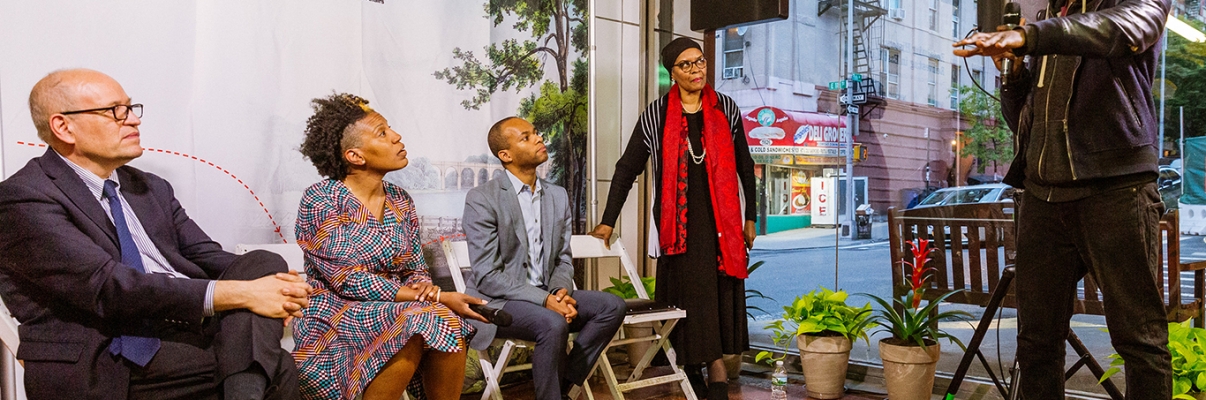
In Summer 2019, NYCEDC and the HABGTF collaborated on a free exhibition at the La Marqueta public market in East Harlem showcasing the history of the Harlem African Burial Ground and the future project on the site. The opening featured a panel discussion moderated by Sharon Wilkins, Manhattan Deputy Borough Historian and HABGTF member.
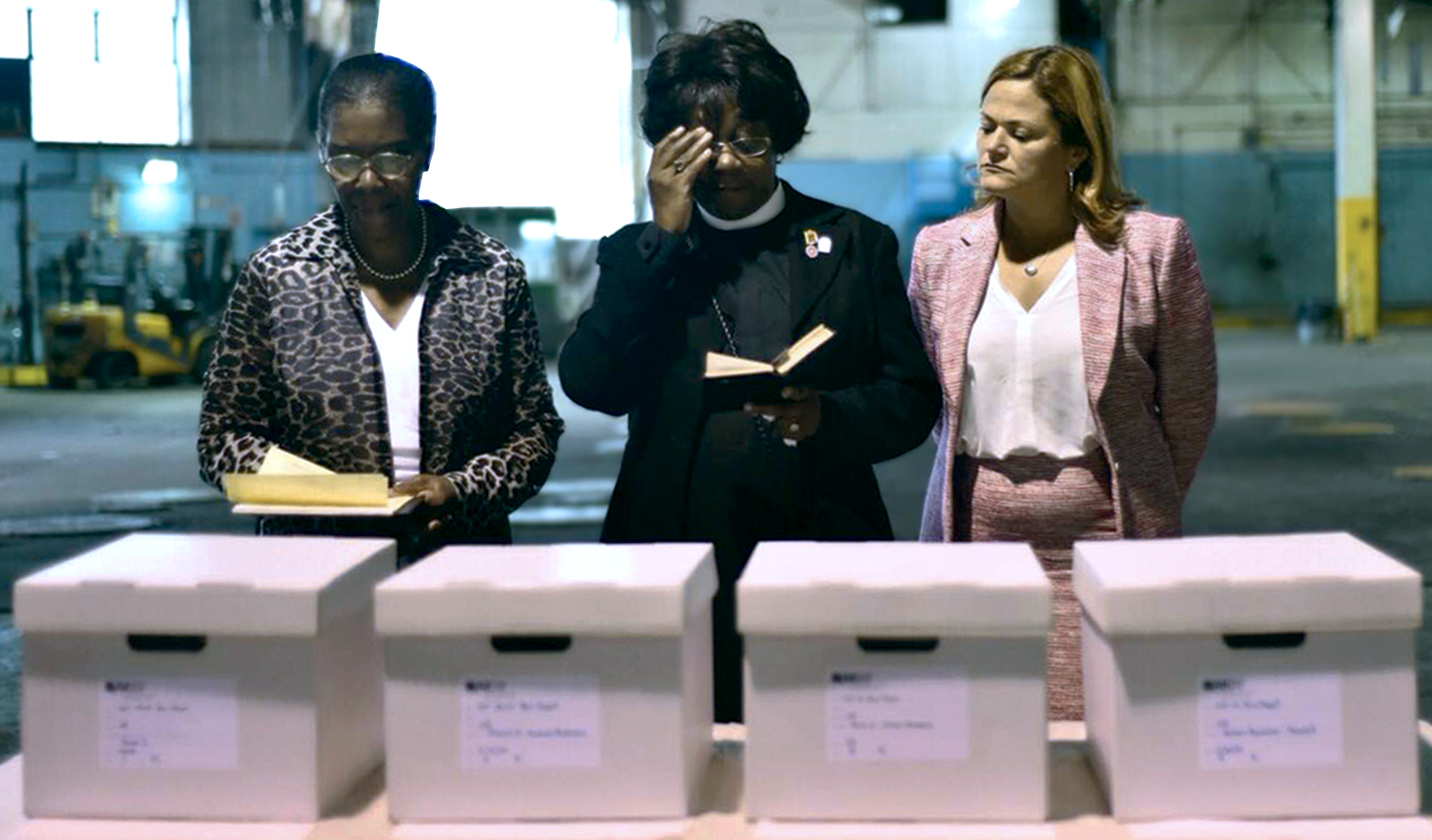
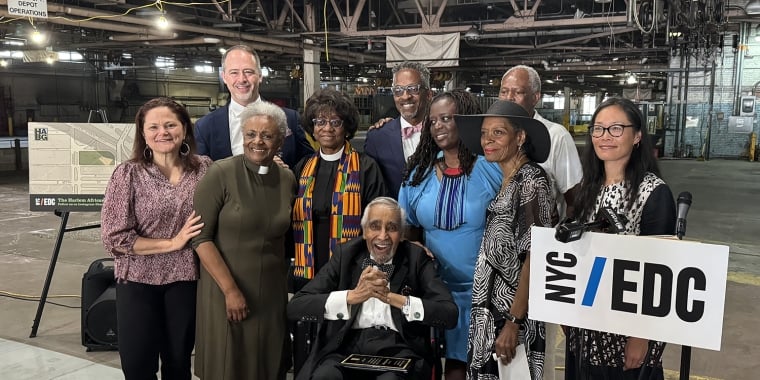
The human remains found at the site of the Harlem African Burial Ground were consecrated in a ceremony led by the HABGTF co-chairs Reverend Dr. Patricia A. Singletary (center), with co-chair and former New York City Council Speaker Melissa Mark-Viverito (right), and Task Force Member Sharon Wilkins (left).
The Vision
Beginning in 2015, NYCEDC worked in partnership with the HABGTF, elected officials, City agencies, and community organizations on a community-based planning process to develop a vision and goals for a future project at the site. In 2017, the project successfully completed the City’s Uniform Land Use Review Procedure (ULURP), and a Points of Agreement (“POA”) letter memorialized the project goals and program developed during the planning process.
This process determined that the future project at the site will include:
- A permanent, public outdoor memorial, to be located on the entire historical footprint of the Harlem African Burial Ground
- An indoor cultural education center dedicated to providing programming about the history and cultural impact and significance of the Harlem African Burial Ground
- Housing, a minimum of 80% of which would be income-restricted affordable homes
- Commercial and retail space
- Additional community facility space
- Streetscape and pedestrian connections to the surrounding neighborhood
- A plan to train and hire East Harlem residents for construction and permanent jobs at the new project
Discovering History Together
From June 2024 to September 2025, NYCEDC and the Harlem African Burial Ground Initiative completed the next phase of archaeological fieldwork. Led by AKRF Inc., this work established the complete distribution of human remains across the site and recovered them alongside artifacts during fieldwork. The human remains and artifacts from the burial ground, at the request of the HABGI, are currently stored at AKRF’s climate-controlled laboratory space in New York City where they will begin analysis in early 2026. To commemorate the completion of archaeology, the project team and the HABGI held a ceremony to honor this work.
The AKRF team is supported by two bioarcheologists, Dr. Rachel Watkins and Dr. Aja Lans, both of whom have expertise in the study of human remains of African descent. Their addition to the team will ensure the human remains uncovered are analyzed with the necessary cultural sensitivity. A Technical Report summarizing the results will be released following their analysis. All human remains will be stored safely until they can be reinterred in the future memorial.
NYCEDC, in coordination with the HABGI and Bridge Philanthropic Consulting, has also completed a wide-reaching, multidisciplinary education and engagement effort to complement this important archaeological work and increase awareness and understanding of the Harlem African Burial Ground. This engagement campaign offered a range of programming catered to all ages, with a particular focus on engaging residents of East and Central Harlem, and beyond. The report released in December 2025, “Unearthing Our Legacy Together: Sharing the History of the Harlem African Burial Ground and Planning for the Future,” summarizes the findings from this effort to inform future stages of this project.

A transcript is available for this video. Click the following link to read the full transcript text. View Video Transcript
What’s Next
As this phase of engagement and archaeology comes to an end, the focus is now on assembling the right team to plan, design, and build the mixed-use development and memorial—creating a physical space to honor the legacy of the Harlem African Burial Ground and those who were laid to rest there. In December 2025, NYCEDC and the Department of Cultural Affairs (DCLA) began a public procurement process to select a nonprofit operator for the future cultural education center, soliciting proposals from cultural and community groups. Learn more about the RFP for the Cultural Education Center.
Following the selection of the operator, the City will issue another procurement to search for a developer team to manage the build-out of the mixed-use program. This developer will work closely with NYCEDC, the cultural education center operator, and the HABGI to bring the vision of the site to life.
-
2025 Engagement Report December 17, 2025
-
Appendix D: Youth Workshop Curriculum December 15, 2025
-
Appendix C: Keepsake Journal - Spanish December 15, 2025
-
Appendix B: Keepsake Journal - English December 15, 2025
-
Appendix A: Stakeholders and Events December 15, 2025
-
Project Update for CB11 November 19, 2025
-
Project Update for CB11 April 17, 2024
-
126th Street Harlem African Burial Ground Memorial and Mixed-Use Project FAQ February 22, 2024
-
Harlem African Burial Ground Town Hall Presentation September 18, 2023
-
Harlem African Burial Ground Brochure
-
Project Update for CB11, Land Use, Landmarks & Planning Committee June 14, 2023
-
La Marqueta Exhibition 2019
-
Points of Agreement (POA) Letter 2017
-
Phase 1B Archaeological Investigation 2016
-
Phase 1A Archaeological Assessment 2011
-
Past: E126th Street Info Session Boards Harlem African Burial Ground Task Force Vision & Mission Statements
-
Present & Future: E126th Street Info Session Boards Context map and more
Learn More
For questions or more information, please email the NYCEDC project team.
Sign up for project updates via our quarterly newsletter.
Follow us on Instagram.