Blue Highways

The Blue Highways program activates the city’s waterways for local and regional movement of goods—improving quality of life for New Yorkers by reducing congestion on our roadways, adding resiliency to the city’s supply chain, and tapping into our roots as a port city.

The Blue Highways Action Plan
New York City’s vision to reduce pollution and bring jobs to New Yorkers by shifting freight from our streets to our waterways.
Read the Action PlanThe goal of Blue Highways is to move goods that arrive at New York and other East Coast ports into and out of the city by water, utilizing New York City’s 520 miles of waterways. Currently, once arriving at a port, most goods are moved by truck, leading to increased congestion, pollution, and roadway damage.
projected increase in freight volume by 2045
As freight volumes are projected to increase another 67 percent in New York City through 2045, finding new ways to address these challenges is essential. The New York City Economic Development Corporation (NYCEDC) and the Department of Transportation (DOT) jointly lead the initiative. Learn more about Blue Highways through the DOT.

Blue Highways is New York City’s vision for moving freight by water, reducing congestion while creating well-paying maritime jobs and strengthening local supply chains. Learn how New York City is becoming the hub of a cleaner, more efficient transportation network.
A transcript is available for this video. Click the following link to read the full transcript text. View Video Transcript
Moving Goods, from Micro to Bulk
Blue Highways is New York City’s brand for what the industry calls short sea shipping. Blue Highways freight falls into three categories: microfreight, containerized freight, and bulk freight. Microfreight includes the movement of parcels and food via containers that attach to e-cargo bikes, containerized freight is the movement of freight via 40-foot shipping containers, and bulk freight comprises a broad category that includes aggregate (also known as building materials), Department of Sanitation (DSNY) municipal bulk (including solid waste, organic waste, as well as salt and dirt required for DSNY’s winter snow operations), liquid and dry bulk such as oil, and project cargo for construction projects. Microfreight and bulk freight require different loading/unloading facilities, but each helps reduce roadway usage.
Microfreight-based goods can be transported via ferry or catamaran-style vessel in small container pallets, with those containers then attached to cargo bikes for last mile delivery to homes and businesses. Cargo bikes improve speed of freight delivery in dense neighborhoods that trucks and vans have trouble negotiating.
Containerized and bulk freight are typically transported by barge, with goods either driven onto the barge via a ramp (known as Roll on/Roll off, or RORO) or lifted onto the barge via crane (Lift on/Lift off, or LOLO).
Projects in Development
Downtown Skyport
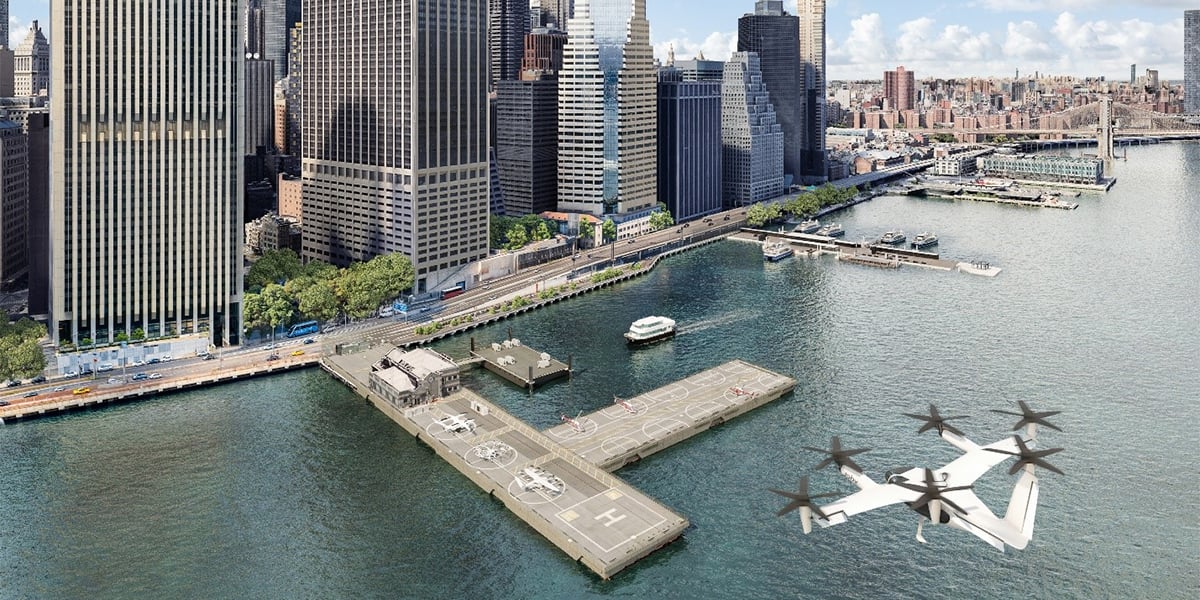
Formerly called the Downtown Manhattan Heliport, the Downtown Skyport is being transformed from a heliport into a multi-modal hub for sustainable transportation and last-mile freight delivery. NYCEDC is upgrading the City-owned site’s infrastructure for electric vertical take-off and landing (eVTOL) aircraft, a quieter alternative to helicopters; and building out maritime freight berthing infrastructure to make New York City’s Blue Highways a reality. Learn more.
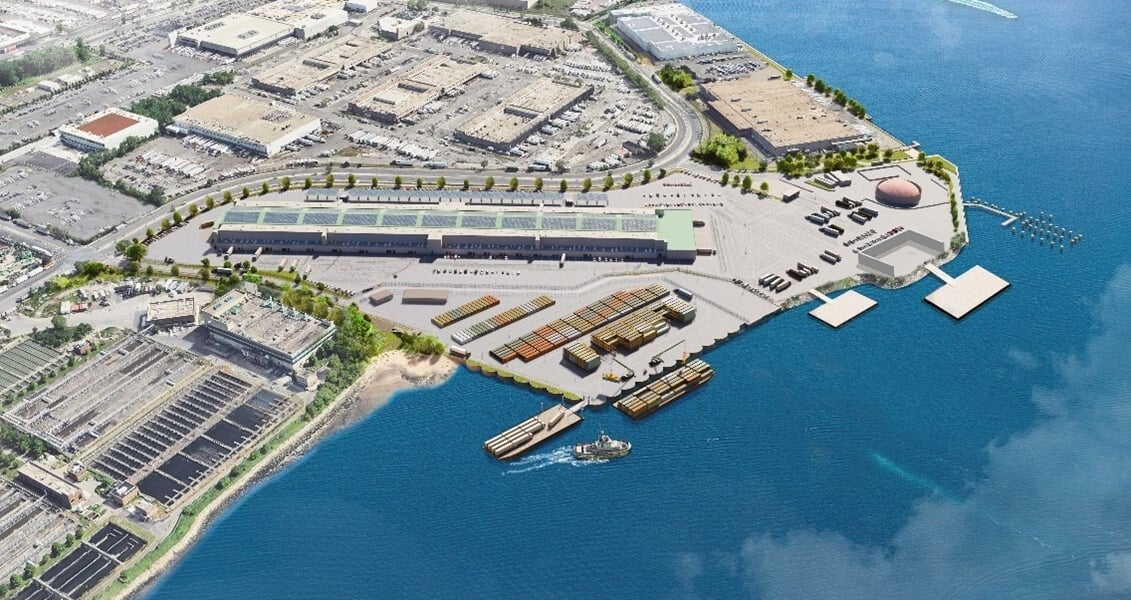
Hunts Point Terminals
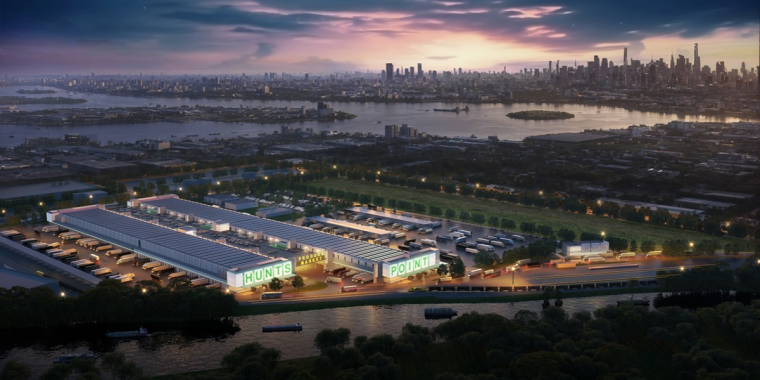
NYCEDC has announced two marine terminal projects at Hunts Point in the Bronx: a Hunts Point Marine Terminal for the importation of containerized freight, and a waterside transloading facility for aggregate and microfreight. Together, these two projects will allow goods to be moved into and out of the Hunts Point Food Distribution Center via water.
The waterside transloading facility is a partnership between NYCEDC, the Fulton Fish Market, and Con Agg Global adjacent to the Fulton Fish Market hub in the Hunts Point Food Distribution Center. The initial facility is expected to remove approximately 1,000 truck trips per month in the South Bronx. A permanent facility will primarily be used for the waterborne movement of wholesale food and beverage and will employ microfreight as well as bulk, both of which help mitigate roadway congestion in and out of the Hunts Point peninsula. Learn more.
Pilot Development
For companies interested in working with NYCEDC and DOT on being a pilot route, see our Pilot Development Checklist.
Ports and Transportation: NYCEDC develops freight and passenger infrastructure to strengthen the region’s economic growth.

Contact Us
To learn more about the Blue Highways program contact our team.
Kerry Goleski, Sustainable Freight Program Lead, DOT