NYCEDC and NYC DOT Launch Blue Highways Action Plan to Revitalize Short Sea Shipping and Transform Urban Freight Movement
Blue Highways program Will Move Freight from Roadways to Waterways, Lowering Truck Congestion and Harmful Emissions and Boosting Economic Growth
Blue Highways Action Plan Builds on Two Years of Steady Blue Highways Progress in New York City
NEW YORK, NY—The New York City Economic Development Corporation (NYCEDC) and the New York City Department of Transportation (NYC DOT) today announced the launch of the Blue Highways Action Plan, a comprehensive report focused on actionable steps to revive short sea shipping and maritime freight movement throughout New York City waterways. This plan marks a major milestone in reimagining the city’s waterfront, reducing truck congestion, and creating new pathways for economic opportunity and sustainability through investments in maritime freight infrastructure. The Blue Highways Action Plan is also a major step forward in the effort to build the Harbor of the Future—a reimagined network of innovation and growth across New York City’s waterways. NYCEDC’s recent workforce development report, NYC’s Working Waterfront: A Blueprint for Blue Highways, projects that the maritime sector will support 117,000 jobs in New York City by 2035. This expansion will create new roles in port operations, shipbuilding, logistics, and last-mile delivery, strengthening local businesses and communities.
With freight volumes projected to grow by 67 percent through 2045, congestion and emissions from truck traffic pose increasing challenges to New York City’s quality of life and infrastructure. Each day, more than 44,000 trucks cross critical chokepoints like the George Washington and Verrazano Bridges, leading to delays costing the city an estimated $20 billion annually in lost productivity, increased maintenance, and environmental impacts.
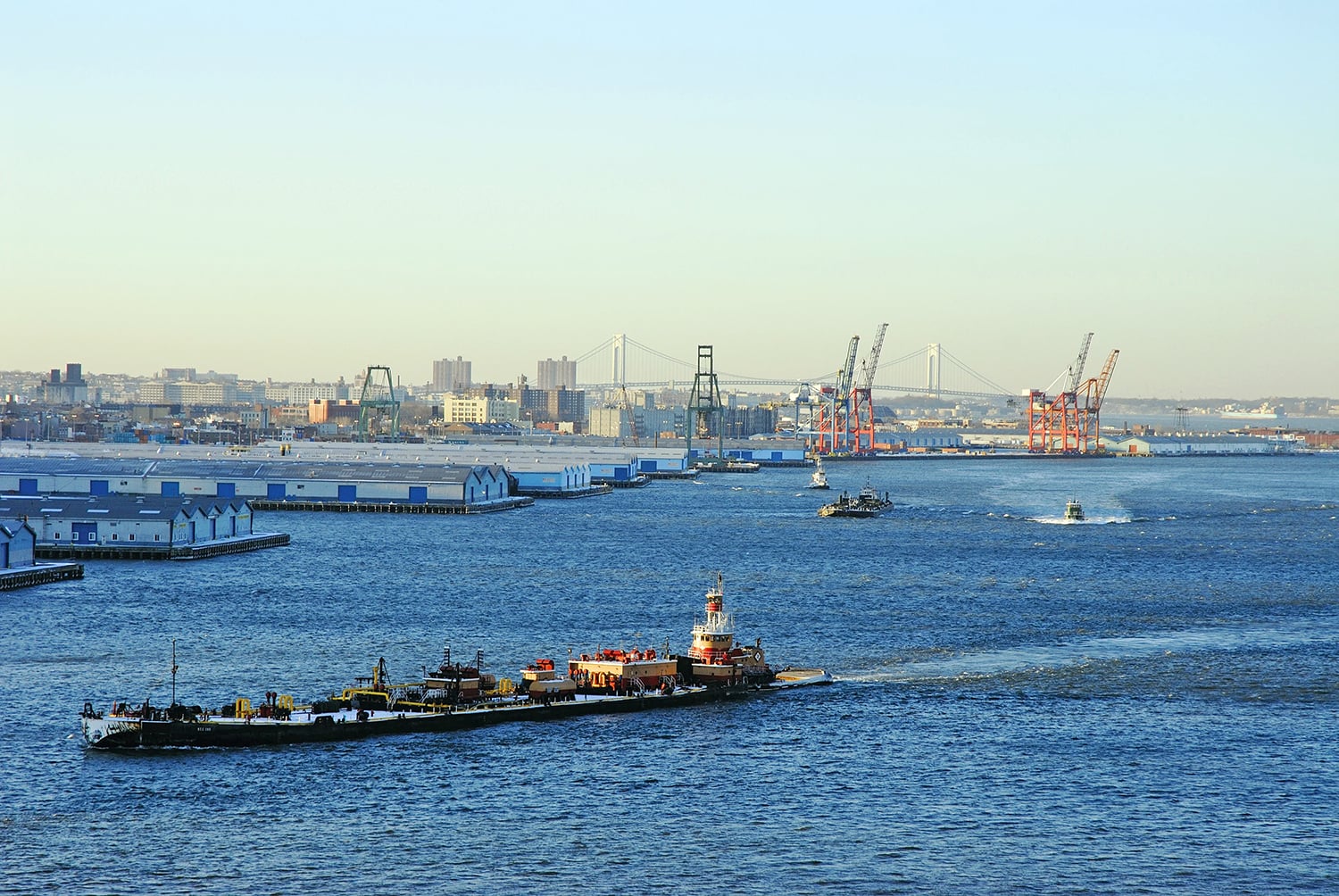
The Blue Highways Action Plan proposes a strategic shift: moving a significant portion of freight deliveries off crowded streets and onto the city’s navigable waterways, taking advantage of 520 miles of waterfront and last mile microdelivery by commercial cargo bike. By leveraging publicly controlled waterfront assets, partnering with private industry, and investing in supportive infrastructure for last mile microdeliveries, the plan aims to reduce congestion, pollution, and roadway wear—while catalyzing economic growth and job creation.
“The Blue Highways Action Plan is our citywide commitment to innovation, sustainability, and equity—leveraging our storied waterfronts to get trucks off our streets and goods back on the water,” said NYCEDC President & CEO Andrew Kimball. “This initiative will reinvigorate long-neglected waterfront sites and reinvent how cargo—from the largest shipping container to the smallest e-commerce package—moves throughout our city. Our waterfronts will once again be engines of opportunity, generating good-paying jobs and improving the lives of all New Yorkers.”
“The Blue Highways program is a key component of unlocking the potential of our waterways to meet the City’s freight needs—and with this Action Plan, New York City is charting a course toward a cleaner, safer, and more resilient freight system,” said NYC DOT Commissioner Ydanis Rodriguez. “We are excited to be collaborating with EDC and other sister agencies as we leverage DOT’s existing freight reform work by piloting new freight routes and vessels to foster a more resilient, sustainable, and inclusive future.”
“Trucks are clogging our streets and vehicle exhaust is poisoning our communities – meanwhile New York's greatest potential transit resource, our waterways, go underused,” said U.S. Representative Dan Goldman. “This release of the Blue Highways Action Plan is a positive next step in finally realizing the full potential of New York Harbor for creating jobs and sustainably moving goods and people throughout the region.”
“For years, communities like Red Hook and Sunset Park have borne the brunt of ever-increasing truck traffic that makes our streets dangerous and smothers us in pollution. But we don't have to live that way,” said State Senator Andrew Gounardes. “This plan is a roadmap—or should I say, a waterway—toward a future that's both more sustainable and that creates more economic opportunity for all New Yorkers. Thanks to EDC for this crucial initiative.”
“As Chair of the Committee on Economic Development, I know that revitalizing working waterfronts is an economic and environmental imperative. The Blue Highways Action Plan reimagines how freight moves through our city-tackling congestion, pollution, and inequity. By shifting deliveries onto waterways and investing in last-mile solutions that create good union jobs, we're proving that innovation and sustainability can go hand in hand,” said Amanda Farías, Majority Leader and Chair of the Committee on Economic Development. “With work already underway on the new Hunts Point Marine Terminal here in the Bronx and the training programs at SUNY Maritime, Bronx Community College, and Rocking the Boat preparing the next generation of maritime and clean-tech workers, the Bronx is poised to lead this new era of green, water-based industry.”
“Representing a district that includes the world's largest food markets and an abundance of heavy, industrial businesses, I’m proud to support the Blue Highways Action Plan—a bold, forward-thinking initiative that will modernize how goods move across our city while cutting down on pollution and truck congestion in our neighborhoods,” said New York City Council Member Rafael Salamanca. “For communities like Hunts Point, which has long borne the brunt of heavy truck traffic, this plan represents real progress. The creation of the Hunts Point Marine Terminal Station as part of the Blue Highway system will not only reduce emissions and ease the burden on our local streets, but also create good-paying, sustainable jobs right here in the South Bronx. The Blue Highways Action Plan is an investment in cleaner air, stronger local economies, and a more resilient future for all New Yorkers.”
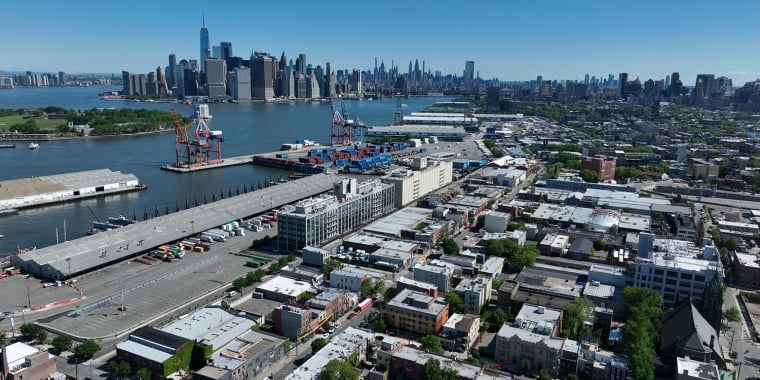
During this administration, progress on the Blue Highways program has accelerated rapidly. In the past two years, more tangible steps have been taken than in the previous two decades, including the creation of pilot routes using existing City assets, the announcements of a new Hunts Point Marine Terminal, a micro-freight facility at Downtown Skyport, as well as the recently approved and historic Brooklyn Marine Terminal (BMT) redevelopment project, which after more than a year of extensive engagement with community members and stakeholders, was passed by two-thirds majority to transform BMT into a fully electric, modern maritime port and vibrant mixed-use community. Additionally, the Action Plan lays out a clear agenda to build on these recent successes:
- Comprehensive analysis of the three service lines of the Blue Highways program—microfreight, containerized freight, and bulk freight—as well as the vessels and infrastructure required to operationalize them.
- Mapping and assessment of 25+ Blue Highways “opportunity sites” for activation, ranging from old piers to ferry landings to container terminals, matching site characteristics to potential services.
- Tangible maritime infrastructure projects for short-term, medium-term, and long-term activation.
- Engagement with industry partners such as DutchX, U.S. Coastal Service, and Sixth Borough Marine, who are investing in new vessels, logistics hubs, and innovative delivery models.
- Creation of a Blue Highways Advisory Council in early 2026, ensuring continued dialogue and collaboration between public and private stakeholders.
One major component of the Blue Highways program is the prioritization of microfreight mobility—small parcel- or package-oriented delivery with an emphasis on food, beverage, and small shipments destined for local markets—to aid in removing trucks from the streets. Unlike large trucks, microfreight mobility requires less space at the port sites, uses smaller, cleaner, micromobility vehicles—like cargo bikes—for last-mile delivery. Microfreight vehicles possess greater maneuverability in dense, crowded neighborhoods that have closely-spaced deliveries, and will have lesser impacts on communities while also addressing increased demand since the COVID-19 pandemic for more frequent local deliveries. As microfreight landings come online, NYC DOT is focused on the use of commercial cargo bikes and other freight micromobility to execute on the promise of clean, last-mile delivery.
According to an analysis conducted by NYCEDC, each maritime trip will replace dozens of truck trips, delivering large-scale benefits to neighborhoods disproportionately affected by truck traffic, and early pilots and investments are already yielding results, with the newly announced Con Agg Global (CAG) Blue Highways facility adjacent to the Fulton Fish Market hub in the Hunts Point Food Distribution Center expected to remove approximately 1,000 truck trips per month from the South Bronx.
By shifting freight from trucks to ships and promoting low-emission last-mile delivery methods—such as pedal-assist electric cargo bikes—the Blue Highways Action Plan will dramatically lower greenhouse gas emissions and improve air quality while also improving street safety for the communities where deliveries are occurring and where ports are located. Each cargo bike in service saves seven tons of CO2 annually, with the potential to replace two vans or box trucks per day. The plan supports the city’s broader sustainability goals, including cutting transportation emissions in half by 2030. Cleaner waterways, electrified vessels, and innovative logistics will contribute to a healthier, more resilient urban environment. Blue Highways will also enhance the resilience of New York City’s supply chain by creating alternative pathways for goods movement—bypassing congested bridges and tunnels. In times of natural disaster or infrastructure disruption, maritime routes offer critical redundancy, ensuring food, materials, and essential goods can reach communities swiftly and reliably.
With nearly 90 percent of goods moving into and through the city by truck, the Blue Highways Action Plan is part of NYC DOT's broader efforts to reimagine freight delivery in New York City, restructure freight distribution, and create a sustainable last-mile delivery system for getting goods where they need to go.
This action plan builds on numerous freight reform efforts undertaken by the Adams Administration that include:
- Curb Management Action Plan – Demand for curb space in New York City—from trash collection and bike lanes to truck loading and parking—is increasing and NYC DOT is responding to address these new demands. ‘Smart Curbs,’ ‘Microhubs’ and the broader Curb Management Action Plan, released in September 2023, are efforts to address the dynamic community needs of today while better preparing the city's streets for the future. These efforts build on the core tenets of the 'New' New York panel's action plan, which identified public space as a key force for the city's economic recovery. As part of the Curb Management Action Plan, NYC DOT launched the 'Smart Curbs' program on the Upper West Side in 2024 to implement and evaluates new treatments and regulations to improve safety, reduce congestion, create vibrant and clean public spaces, support orderly local deliveries, and more.
- Cargo Bike Rulemaking – In March 2024, the agency authorized the use of e-cargo bikes on city streets to make deliveries safer and more sustainable. Since the inception of the cargo bike pilot program, the use of commercial cargo bikes for deliveries has grown at least seven-fold with an expectation for continued expansion with the City’s support.
- Off-Hour Delivery Program – In August 2024, NYC DOT launched applications for its Off-Hour Deliveries (OHD) incentive program to encourage goods delivery during the off-peak hours of 7 p.m. and 6 a.m. in efforts to decrease congestion, double parking, and truck emissions. One-time monetary reimbursements will help businesses make the switch to off-peak deliveries. For more information visit nyc.gov/ohd.
- Microhubs – In April of this year, NYC DOT also launched the first pilot locations for the 'Microhubs' program that established safe, dedicated spaces for truck operators to transfer deliveries onto safer and more sustainable modes of transportation for the last leg of delivery, including e-cargo bikes, handcarts, and smaller electric sprinter vans.
- LockerNYC – In September 2025, the agency expanded its secure public delivery locker pilot to reduce truck traffic and cut down package theft, adding six new Go Locker locations as part of the LockerNYC program.
About NYCEDC
New York City Economic Development Corporation is a mission-driven, nonprofit organization that works for a vibrant, inclusive, and globally competitive economy for all New Yorkers. We take a comprehensive approach, through four main strategies: strengthen confidence in NYC as a great place to do business; grow innovative sectors with a focus on equity; build neighborhoods as places to live, learn, work, and play; and deliver sustainable infrastructure for communities and the city's future economy. To learn more about what we do, visit us on Facebook, X, LinkedIn, and Instagram.
About NYC DOT
The New York City Department of Transportation’s (NYC DOT) mission is to provide for the safe, efficient, and environmentally responsible movement of people and goods in the City of New York and to maintain and enhance the transportation infrastructure crucial to the economic vitality and quality of life of our primary customers, City residents. NYC DOT’s staff manage an annual operating budget of $1.4 billion and a ten-year $33 billion capital program, along with 6,300 miles of streets and highways, over 12,000 miles of sidewalk, and approximately 800 bridges and tunnels, including the iconic East River bridges. NYC DOT’s staff also installs and maintains nearly one million street signs, 13,250 signalized intersections, over 315,000 street lights, and over 350 million linear feet of markings.