NYCEDC Unveils Strategic Vision for Sustainable Bioeconomy in New York City
Report Highlights New York City’s Leadership in the Sustainable Bioeconomy, a New Sector Poised to Redefine Legacy and Innovation Industries
Investments in Sustainable Bioeconomy Total Nearly $70 Million To Date, Expected to Generate $6 Billion in Economic Output and 1,000 High-Quality Jobs Over the Next Thirty Years
Gotham Foundry, First-Ever Sustainable Materials Innovation Hub, Opens as Cornerstone of Next-Generation Ecosystem
NEW YORK, NY—New York City Economic Development Corporation (NYCEDC) today announced the release of the Sustainable Bioeconomy: New York City’s Strategic Edge report, a comprehensive roadmap identifying the city’s unique strengths and catalytic investments in a rapidly emerging deep tech sector that is poised to accelerate sustainable transformation and inclusive economic growth in several legacy industries. Alongside the report’s publication, today, NYCEDC and its consortium of academic and community partners celebrate the official opening of Gotham Foundry, the country’s first-ever sustainable materials innovation hub and a cornerstone of the City’s emerging sustainable bioeconomy. Gotham Foundry will initially be located at Harlem Biospace on Columbia University’s Manhattanville campus.
The sustainable bioeconomy represents a new deep tech sector in which biology, engineering, chemistry, and artificial intelligence (AI) converge to create innovative solutions for climate and sustainability challenges spanning industries including fashion, construction, healthcare, and food. From vegan leather, alternative proteins for food production, and biodegradable gels for home, personal, and medical care, to mass timber in construction and the ability to mine metals from waste, biotechnology is unlocking our ability to make sustainable products we can see, touch, and taste in new ways. As highlighted in the report, New York City is uniquely equipped to capitalize on this opportunity, leveraging world-class research institutions, a diverse industrial base, and decades of experience in future-focused innovation.
The report details how NYCEDC is continuing to grow the sustainable bioeconomy and material innovation as outlined in the city’s Green Economy Action Plan. Foundational public-private partnerships and strategic public investments totaling nearly $70 million are expected to generate $6 billion in economic output and over 1,000 high-quality jobs across all five boroughs over the next thirty years. The World Economic Forum estimates that the global bioeconomy is worth $4 trillion in 2025 and the McKinsey Global Institute states that, “60 percent of the physical inputs to the global economy could, in principle, be produced biologically.”
“As a leader in technology, the green economy, and life sciences—and as a global headquarters of diverse industries—New York City is setting the pace for a new era in sustainable innovation,” said NYCEDC President & CEO Andrew Kimball. “The actions outlined in the Sustainable Bioeconomy Report, coupled with the launch of Gotham Foundry, represent the first unified vision for this growing deep-tech sector. Unprecedented challenges require unprecedented solutions, and through these investments, NYC is poised to shape the future.”
“The NYCEDC’s support and partnership have been invaluable to Gotham Foundry as we build a one-of-a-kind hub for regenerative material design and green manufacturing,” said Helen Lu, Director of Gotham Foundry, Percy K. and Vida L.W. Hudson Professor of Biomedical Engineering at Columbia University. “This new initiative will go a long way toward advancing innovation, creating new jobs, training a skilled workforce and driving the green economy here in New York City and beyond.”
“New York has a unique combination of world-class research institutions and diverse consumer markets that make it a compelling launchpad for the sustainable bioeconomy,” said President & CEO at the Partnership Fund for New York City Maria Gotsch. “With programs, investments, and infrastructure projects like Gotham Foundry, SOSV’s IndieBio, and BATWorks already catalyzing development, the city is well positioned to translate breakthrough science into long-term economic growth and job creation to benefit New Yorkers for years to come.”
The sustainable bioeconomy applies a green lens to biotechnology to bring biobased and bioinspired innovations to legacy industries, like fashion, construction, food, and healthcare. The Sustainable Bioeconomy Report identifies six innovation verticals—Materials, Food, Agriculture, Home, Medical & Personal Care, Energy, and Environment—where biobased and bioinspired innovations are reshaping legacy industries core to New York City’s economy. The convergence of these innovation and legacy industries creates a unique opportunity for New York City to offer first-of-its-kind support for the creation, scale, and adoption of new solutions while expanding economic opportunity for New Yorkers.
Anchoring the city’s investments in this sector, Gotham Foundry officially opens as the first-of-its-kind sustainable materials innovation hub, following a contingent award of $45 million to Columbia University, CUNY Advanced Science Research Center (ASRC), Fashion Institute of Technology (FIT), and Genspace. Gotham Foundry is designed to support the next frontier of sustainable materials—including new bioplastics, textiles derived from food products, and other groundbreaking inventions—and is expected to generate $5.14 billion in economic output over the next thirty years while creating more than 650 high-quality jobs.
Initially located at Harlem Biospace on Columbia University’s Manhattanville campus, Gotham Foundry will provide access to specialized equipment, entrepreneurial support, and commercialization expertise as well as industry-specific-support at partner sites at CUNY ASRC and FIT. This collaborative ecosystem will nurture early-stage deep tech companies and translational research, accelerating the development of sustainable materials for industries such as fashion, construction, food, packaging, and healthcare.
“Manhattanville continues to grow as a home for innovation, and it is exciting that it will be a significant site within the city’s new strategic vision for a sustainable bioeconomy,” said Council Member Shaun Abreu. “The vision will put to action what we know to be true: sustainability and economic growth can and must go hand in hand. The launch of Gotham Foundry and NYCEDC’s new roadmap not only tackles our more pressing climate challenges, but also demonstrates how a sustainable bioeconomy can catalyze new industries, reliable jobs, and opportunities for our communities here in Upper Manhattan. I am proud to see our local institutions lead the way to building a greener, more resilient, and more just future.”
“At SOSV, we’ve spent more than a decade investing at the forefront of human and planetary health. In supporting hundreds of founders, we’ve seen firsthand the talent, infrastructure, and capital it takes to transform bold ideas into lasting impact,” said Sabriya Stukes, Partner at SOSV and Chief Scientific Officer of IndieBio New York. “We are pleased to see a number of our companies highlighted in this report and are excited to keep building on this momentum, making New York the go-to destination for startups driving innovation across these vital sectors.”
In addition to Gotham Foundry, the report highlights several core investments that will support companies on their path to scale:
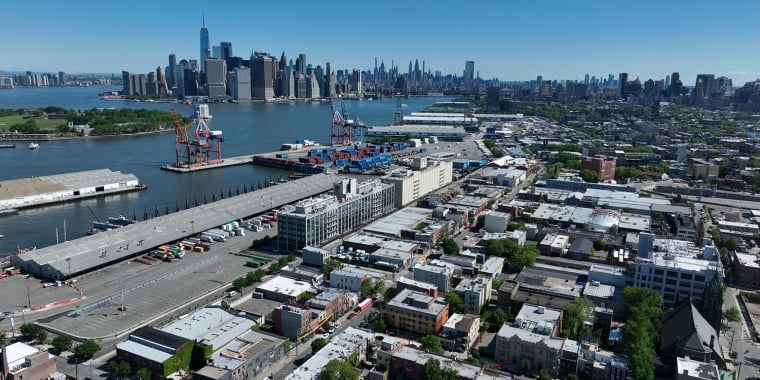
- Brooklyn Navy Yard Development Corporation (BNYDC) and NYCEDC have partnered to create 50,000 square feet of graduation space for companies across the innovation industries and the sustainable bioeconomy, including $12.8M to house up to ten companies in Brooklyn Navy Yard Building 303—further cementing the sustainable bioeconomy ecosystem at the Navy Yard. NYCEDC’s investment and partnership with BNYDC is projected to create $941M in economic output and 218 jobs.
- BATWorks is a cutting-edge climate innovation hub at the Brooklyn Army Terminal (BAT) in Sunset Park that will anchor a growing ecosystem along New York Harbor for new climate technologists, entrepreneurs, and talent working to develop, pilot, and deploy new solutions to combat the effects of climate change.
- Pilots at BAT is providing emerging climate technology companies space at the Brooklyn Army Terminal (BAT) to test their products in a live built environment and ultimately grow their business and impact throughout the five boroughs to confront the climate crisis. The program supports biobased material startups, such as Cast Carbon, Plantd, and BioTwin, by helping them validate their solutions, attract funding, and build strategic partnerships. BATWorks will operate the program beginning in 2026.
- The New York City Mass Timber Studio aims to build capacity across the mass timber industry, to unlock the economic and environmental impact of mass timber, wood products engineered to form structural building components. The studio will help New York City achieve its climate goals and inform regulatory processes to ensure safe and efficient construction of mass timber projects across building typologies.
Central to the city’s strategy to grow the sustainable bioeconomy is building an equitable pipeline of talent. Programs such as the LifeSci NYC Internship, Break into Biotech (in partnership with Genspace), and BioBus STEM education initiatives are preparing New Yorkers for high-quality jobs across science, technology, healthcare, and the green economy. Gotham Foundry’s workforce development programming, launched at Harlem Biospace, will continue to train students and entrepreneurs in fashion, construction, and materials innovation, ensuring that the city’s workforce reflects the diversity and ingenuity of its communities.
This announcement also builds on NYCEDC’s Academia Report and is a reflection of the City’s commitment to deepening its partnerships with academia to strengthen the city’s talent pipeline, research capacity, innovation, and growth.
About NYCEDC
New York City Economic Development Corporation is a mission-driven, nonprofit organization that works for a vibrant, inclusive, and globally competitive economy for all New Yorkers. We take a comprehensive approach, through four main strategies: strengthen confidence in NYC as a great place to do business; grow innovative sectors with a focus on equity; build neighborhoods as places to live, learn, work, and play; and deliver sustainable infrastructure for communities and the city's future economy. To learn more about what we do, visit us on Facebook, X, LinkedIn, and Instagram.