NYCEDC Launches First-Ever Pilot of a Circular Construction Hub at MADE Bush Terminal
Partnership with operator Our Temenos Marks First Award from NYCEDC's "Ideas for Impact" RFEI
Year-Long Pilot to Focus on Recovery, Sorting, Storage, and Redistribution of Select Construction Materials to Reduce Waste, Extend Lifecycles, and Generate Feasibility Data
BROOKLYN, NY—New York City Economic Development Corporation (NYCEDC) today announced the launch of a year-long pilot of the Circular Construction Hub at MADE Bush Terminal in Sunset Park, Brooklyn. The hub will be operated by Our Temenos, a Brooklyn-based ecological landscaping firm, and will focus on the recovery, storage, sorting, and redistribution of construction materials to reduce waste, extend material lifecycles, and generate real-world data on the feasibility of reuse-oriented construction supply chains within New York City. The initiative will inform future efforts to scale programmatic investments supporting the implementation of circular construction practices citywide, advancing both climate goals and the continued growth of the green economy.
“Right now, when a construction site in our city tears something out, most of it ends up in a landfill, even when it can still be used,” said New York City Mayor Zohran Kwame Mamdani. “This pilot is about changing that. We’re going to recover those materials at MADE Bush Terminal, store them and put them back to work. We own this land, and we have a responsibility to use it to test what’s possible at a larger scale. If this works, we can cut waste, lower costs and build a city where we make better use of what we already have.”
“Construction and demolition debris accounts for 40% of the City’s total waste generation and represents a major stream of carbon emissions and economic value that can be recaptured and reused,” said NYCEDC's Interim President and CEO Jeanny Pak. “Cities have a responsibility to create the conditions for innovation to succeed, and by partnering with Our Temenos through this pilot, NYCEDC is helping de-risk new approaches to material reuse and generating the real-world data needed to understand how circular construction can shape the future of building in New York City.”
“As landscape contractors with experience building residential and public green spaces, we had a keen awareness as to why salvage and surplus material use wasn’t scaling. It is part of our work as green infrastructure professionals to solve everyday problems, so we turned that lens back on the supply chain!” said Our Temenos and Circular Construction Hub Founder Rosemarie Miner. “Since inception, we have been designing spaces that reused materials on site or at our disposal – it only made sense to scale our model in support of the stabilization of our industry. Small construction businesses face a lot of challenges with market volatility and losses from climate change, whether that’s weather-related delays or unpredictable supply chains. We are building a hyperlocal resource to strengthen our local community and support the people that build it.”
The partnership between NYCEDC and Our Temenos to pilot the new hub evolved from an “Ideas for Impact” Request for Expressions of Interest (RFEI) submission—marking the first award of its kind. The “Ideas for Impact” RFEI is an open solicitation, inviting nonprofits, startups, academic institutions, community organizations, and other mission-aligned entities to propose innovative partnership opportunities that advance NYCEDC's economic development priorities.
Our Temenos is a Brooklyn-based, certified M/WBE ecological landscaping firm that focuses on habitat restoration, low-waste landscape design and operations, and material reuse initiatives. Our Temenos is a graduate of NYCEDC's Waterfront Pathways Program, which helps minority- and women-owned businesses build the technical expertise, industry relationships, and business capacity needed to pursue opportunities in New York City's growing green economy. The firm also participated in NYCEDC’s ConstructNYC Green Training program, a 39-hour training module focused on circular and sustainable construction management. As the operator of the hub, Our Temenos will test material intake, handling, and resale activities, while NYCEDC will evaluate the long-term operational model and economic viability through their data collection. This collaboration is essential to understanding the infrastructure investments needed to scale interim material storage, handling and reprocessing within New York City.
“Construction and demolition accounts for a massive share of New York City’s waste stream,” said DSNY Commissioner Gregory Anderson. “New York City residents do their part to separate recyclable and compostable materials and divert them from landfill, and we encourage the construction industry to also look for ways to reduce, reuse and recycle their materials and lessen our collective carbon footprint. The Circular Construction Hub will do just that, utilizing on-the-ground experience from an innovative, forward-thinking firm with a history of low-waste design operations. I thank the team at NYCEDC and Our Temenos, and we look forward to working with them to divert these valuable materials for reuse.”
“AIA New York commends NYCEDC for their continued leadership advancing our city’s circular economy,” said Jesse Lazar, Executive Director of the American Institute of Architects New York Chapter. “The Circular Construction Reuse Hub serves as a critical asset, simulating innovation and bolstering the green economy, by unlocking opportunities to treat existing buildings and materials as valuable resources to be repurposed. This pilot will build out the type of physical infrastructure necessary to support material reuse at scale—a recommendation detailed in the New York Embodied Carbon Action Plan, a tangible roadmap developed by industry experts to strategically reduce embodied carbon emissions in the built environment and create green jobs.”
“Our buildings and the materials within them are valuable and should be reused whenever possible. The Circular Construction Hub will enable the real estate industry to divert even more materials away from landfills by providing a much-needed physical place of exchange. This effort will support a local circular economy and lower the embodied carbon of our built environment,” said Sydney Mainster, Vice President of Sustainability and Design Management at The Durst Organization.
“Creating real opportunities to implement circular construction practices is a welcome and meaningful step forward in supporting the transition to a greener and more sustainable future,” said State Senator Brian Kavanagh, who chairs the Senate Housing Committee. “A dedicated space for focusing on the recovery, storage, and re-use of construction materials will help advance our important work to reduce carbon emissions and promote sustainable building practices, efforts that I have been proud to lead on in the Senate. I congratulate NYCEDC and Our Temenos on the announcement of this Circular Construction Hub, and I look forward to seeing all of the great work that the Hub does in the coming year.”
“Deconstruction and the reuse of building materials, rather than conventional demolition, can divert a tremendous amount of waste from New York’s landfills while reducing the emissions associated with manufacturing new materials. We know valuable materials are being lost, and we know there is interest in using them. What is missing is the infrastructure to recover, sort, store and sell these materials so they are readily available and cost competitive,” said New York State Assemblymember Anna Kelles. “I introduced the Building Materials Reduction, Reuse, and Recycling Act, A8637, to help municipalities adopt enforceable local deconstruction ordinances requiring salvage plans, on-site separation of materials and progressively higher landfill-diversion rates. The bill would also support a network of local material hubs like the Circular Construction Hub operated by Our Temenos and establish a statewide contractor-certification program to build a skilled workforce capable of safely deconstructing buildings at every scale. This pilot will provide the practical information we need to make the recovery and reuse of building materials standard practice across New York.”
In 2024, NYCEDC launched the Clean and Circular: Design & Construction Guidelines, an operational guide to reduce embodied carbon emissions and material waste by encouraging material reuse, deconstruction, and the use of lower carbon building materials across NYCEDC capital projects, advancing a key pillar of the Green Economy Action Plan. Since their launch, the Guidelines have been incorporated across major NYCEDC capital projects, including in both active and upcoming renovation projects at MADE Bush Terminal. Insights gained through early implementation of the Guidelines highlighted the need for both physical reuse infrastructure and stronger data systems to support the transition to closed-loop material supply chains, helping inform initiatives like the Circular Construction Hub pilot at MADE Bush Terminal.
With the buildings sector representing nearly half of New York City's green economy today, expanding circular construction practices presents an opportunity to create new business activity and workforce pathways in areas such as deconstruction, material processing, and logistics. The pilot will help test the market conditions, infrastructure, and operational models needed to support delivery of circular building projects and unlock future opportunities for green jobs and sustainable economic growth.
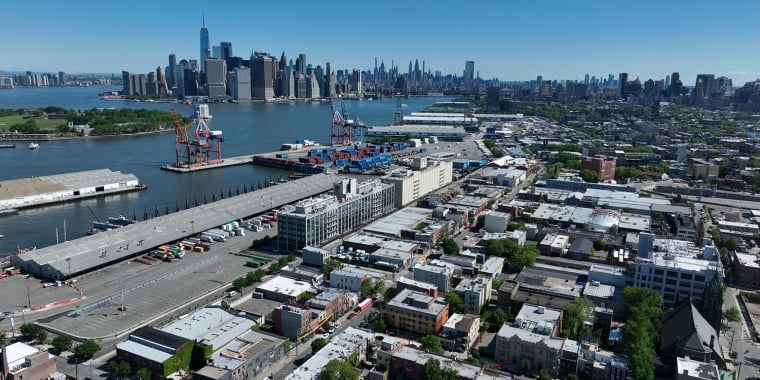
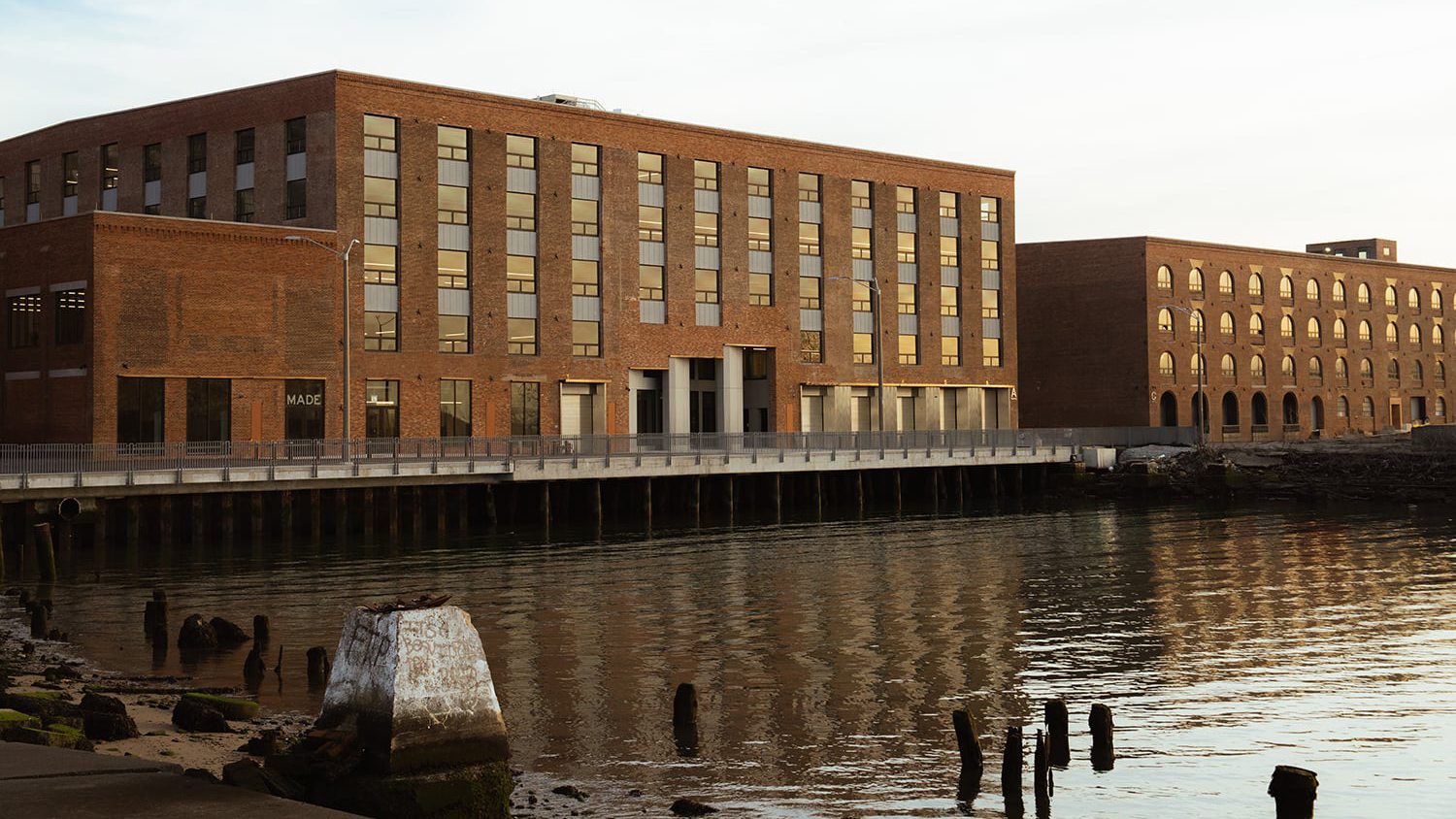
MADE Bush Terminal—short for Manufacturers, Artisans, Designers, and Entrepreneurs—is an ambitious urban redevelopment project transforming a historic 20-acre property into a modern, mixed-use hub for local producers, fabricators and creatives. The reimagined industrial mixed-use campus includes approximately 140,000 square feet of industrial workspace, 30,000 square feet dedicated to cultural and public programming, and acres of new public open space. Central to its development approach is the adaptation of century-old warehouses to preserve the area’s rich industrial heritage and to leverage the useful life of existing materials on site. Situating the hub at MADE Bush Terminal reflects MADE's adaptive reuse approach to development while advancing its goal to implement sustainable operational practices and creating opportunities to test and scale innovative business models. This also aligns with NYCEDC's work to grow the green economy, especially across Sunset Park where NYCEDC is leveraging its assets to achieve this goal.
NYCEDC’s Sunset Park District spans 200 acres of the South Brooklyn waterfront and includes four major industrial campuses—the Brooklyn Army Terminal (BAT), South Brooklyn Marine Terminal (SBMT), MADE Bush Terminal, and the Brooklyn Wholesale Meat Market (BWMM). With its rich industrial history, robust infrastructure, diverse tenants, and strategic access to major transportation networks, the waterfront district is uniquely positioned to serve as a hub for clean energy and sustainable manufacturing. Earlier this year, NYCEDC, in partnership with Los Angeles Cleantech Incubator (LACI), and Cambridge Innovation Center (CIC), announced the opening of the temporary home for BATWorks, the city’s world-class climate innovation hub that will connect New Yorkers to workforce development trainings and jobs in the green economy. The permanent space in BAT Building A is set to open in 2028. NYCEDC is also supporting the transformation of the nearby SBMT into one of the largest offshore wind ports in the nation.
About NYCEDC
New York City Economic Development Corporation is a mission-driven, nonprofit organization that works for a vibrant, inclusive, and globally competitive economy for all New Yorkers. We take a comprehensive approach, through four main strategies: strengthen confidence in NYC as a great place to do business; grow innovative sectors with a focus on equity; build neighborhoods as places to live, learn, work, and play; and deliver sustainable infrastructure for communities and the city's future economy. To learn more about what we do, visit us on Facebook, X, LinkedIn, and Instagram.
About Our Temenos
OUR TEMENOS, founded in 2018, is an ecology driven landscape design and consulting firm dedicated to building biodiverse, resilient, and community-centric green spaces. A member of the Ecological Landscape Alliance, USGBC, and a partner of Homegrown National Parks, the firm offers a full suite of landscape and green infrastructure services including design/build, professional horticultural maintenance, invasive species removal, planning and development (with LEED-ND and WEDG expertise), environmental restoration, and tree pruning and planting with ISA-certified arborists. With a portfolio that spans homes, restaurants, museums, schools, and cultural institutions across New York City, Our Temenos creates landscapes that combine functionality, beauty, and ecological resilience for the future of New York.